

Loading article content...
Sumit was on a week-long holiday abroad when a sudden illness led to a hospital bill of $1,200 (₹1,15,000 approx.). He had travel insurance, so he expected the entire eligible amount to be covered. While filing the claim, however, he noticed that his policy carried a $100 (₹9,600) deductible.
That one line affected how much of his eligible expense would be considered after the deductible.
Many travellers notice the travel insurance deductible only when they are already dealing with an unexpected bill. Understanding the deductible in travel insurance before your trip can help you know how much you may have to bear yourself when making a claim.
What is a Deductible in Travel Insurance?
Think about the last time you bought a comprehensive travel insurance policy. You probably checked the premium, medical coverage and perhaps baggage or trip-related benefits.
But did you check the deductible?
A deductible in travel insurance represents the set portion of costs you must pay out-of-pocket before your insurance provider evaluates and covers any remaining eligible expenses, in accordance with the terms and conditions of your policy.
Suppose your eligible medical expenses abroad amount to $1,000 (₹96,000) and the applicable deductible is $100 (₹9,600).
In a simplified example:
$1,000 (₹96,000) − $100 (₹9,600) = $900 (₹86,400)
This leaves $900 for assessment, though final payout depends on policy terms, limits, and exclusions. Reviewing the deductible amount in travel insurance before purchasing ensures you are not surprised during an emergency abroad.
Note: INR amounts used throughout this article are approximate and for illustration only. Actual values may vary with currency exchange rates.
>> Read More: Travel Insurance Deductible: What You Should Know
How do Travel Insurance Deductibles Work?
A deductible becomes relevant when you make a claim under a benefit where it applies.
Say you are exploring a new city when you slip, injure your ankle and need medical treatment. Your eligible medical expenses come to $600, and your policy has a $50 travel insurance claim deductible. Here's how the basic calculation may look:
| Particulars | Amount |
|---|---|
| Eligible medical expenses | $600 (₹57,600) |
| Applicable deductible | $50 (₹4,800) |
| Amount remaining for claim assessment | $550 (₹52,800) |
The $550 isn't guaranteed as the final amount you will receive. Other policy terms like limits, exclusions, sub-limits, or co-payments can also impact the settlement. Thus, in travel insurance deductibles and claims, deducting this amount is merely the initial step of assessment.
How Does a Deductible Affect a Travel Insurance Claim?
A deductible directly influences how much of an eligible claim remains for assessment by the insurer. The easiest way to understand the deductible impact on insurance claim is through situations you could actually face while travelling. Here are a few scenarios:
Scenario 1: A Minor Illness During Your Holiday
You wake up with a high fever while travelling abroad and visit a nearby clinic. Your eligible consultation, tests and medicines cost $150 (₹14,400). Your travel insurance deductible is $100 (₹9,600).
After the deductible:
$150 (₹14,400) − $100 (₹9,600) = $50 (₹4,800)
Only $50 (₹4,800) remains for further claim assessment. Here, the deductible makes a noticeable difference because the medical expense itself is relatively small.
Scenario 2: An Emergency Hospital Visit
Now suppose you meet with a minor accident during your trip and the eligible hospital expenses reach $2,000 (₹1.92 lakh). Your deductible is still $100 (₹9,600).
After the deductible:
$2,000 (₹1.92 lakh) − $100 (₹9,600) = $1,900 (₹1.82 lakh)
In this case, the same deductible accounts for a much smaller portion of the overall expense.
Scenario 3: Your Expense Is Lower Than the Deductible
Suppose you need a quick medical consultation that costs $80 (₹7,680), while the applicable deductible is $100 (₹9,600).
Since the eligible expense is lower than the deductible, there is no amount remaining after applying it. In such a situation, you may have to bear the entire expense yourself, subject to the exact terms of your policy.
These examples highlight how deductibles impact claims. A $100 (₹9,600) travel insurance claim deductible absorbs a large share of smaller medical bills, but affects major expenses far less. Checking your estimated claim amount after deductible beforehand ensures you know what expense remains for evaluation and prevents surprises.
Note: The examples are illustrative. The actual travel insurance claim after deductible depends on claim admissibility, coverage limits, exclusions, sub-limits and other policy conditions.
How is a Travel Insurance Deductible Calculated?
A travel insurance deductible is generally a fixed amount mentioned in your policy. To understand how it affects your claim, use this simple calculation:
Eligible Claim Amount − Deductible = Amount Remaining for Claim Assessment
For example, suppose you receive an eligible medical bill of $1,000 (₹96,000) during your trip, and your deductible is $100 (₹9,600).
$1,000 − $100 = $900
This means $900 (₹86,400) remains for further claim assessment.
Keep in mind that final payouts depend on policy coverage, limits, and exclusions. Also, check whether your deductible applies per claim, person, or occurrence.
Note: INR values are approximate and used only for illustration.
>> Read More: What Are The Important Factors For Travel Insurance Premium?
Does a Deductible Apply to Every Travel Insurance Claim?
Not necessarily—and this is one detail travellers can easily overlook.
A travel insurance claim deductible may apply differently across policies and benefits. Depending on the terms, a deductible may apply per person, per claim, per occurrence or in another specified manner. Certain benefits may also have no deductible.
Suppose you need medical treatment once during your trip and later experience a completely separate covered incident. Whether another deductible applies will depend on how your policy defines it.
Before buying a plan, check:
- Which benefits have a deductible?
- What is the applicable deductible amount?
- Does it apply per claim, person or occurrence?
- Are any benefits available without a deductible?
- Is there any co-pay or other cost-sharing condition?
A few minutes spent checking these details at home can save a lot of confusion when you are far away.
How Do Medical Deductibles Work During an Overseas Emergency?
Medical emergencies are rarely part of a travel itinerary. You may leave your hotel expecting to spend the day sightseeing and return after visiting a doctor. A fall, infection or sudden illness can change the day—and your travel budget—quickly.
This is where understanding a travel medical insurance deductible becomes particularly relevant.
Suppose an eligible emergency treatment costs $1,500 (₹1.44 lakh) and your applicable deductible is $100 (₹9,600).
After applying the deductible, $1,400 (₹1.34 lakh) remains for further claim assessment, subject to policy conditions.
The medical deductible travel insurance provision does not mean that every expense above the deductible will automatically be paid. Coverage limits, exclusions, co-payments, sub-limits and claim admissibility may still apply.
The takeaway is simple: when comparing medical coverage in an international travel insurance plan, don't look only at the maximum sum insured. Look at what you may need to pay from your own pocket too.
Zero Deductible vs Deductible Travel Insurance
If paying the first portion of a claim yourself does not suit your preference, you may come across zero deductible travel insurance options. Here's a quick comparison:
| Factor | Travel Insurance With Deductible | No Deductible Travel Insurance |
|---|---|---|
| Initial eligible expense | Specified deductible is borne by traveller | No applicable deductible |
| Claim assessment | Deductible is applied first | No deductible subtraction |
| Out-of-pocket amount | May include the deductible | No deductible for that benefit |
| Other policy terms | Continue to apply | Continue to apply |
While travel insurance with no deductible may sound attractive, the deductible alone should not decide which policy you purchase. Compare the premium, medical coverage, exclusions, sub-limits, trip-related benefits and other conditions as well.
What Should You Check About Deductibles Before Buying Travel Insurance?
Before buying travel insurance, it is important to understand how a travel insurance deductible can affect your out-of-pocket expenses during a claim. Here are a few things to check to avoid unexpected costs when you need your coverage most.
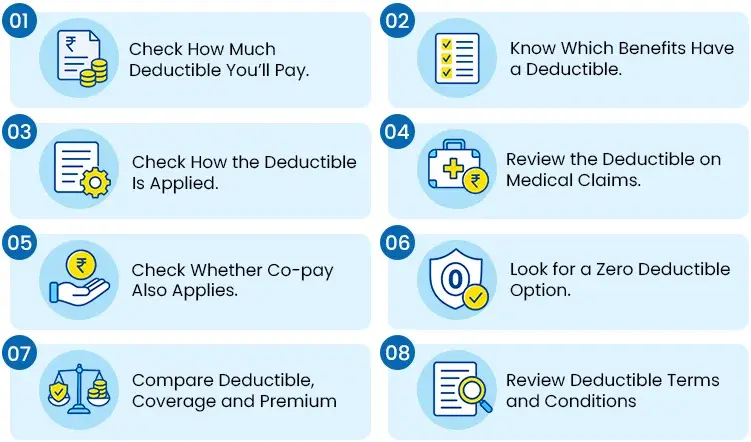
Deductible vs Co-pay vs Coverage Limit: Know the Difference
When filing a travel insurance claim, terms like deductible, co-pay and coverage limit can sound similar. However, each can affect your claim differently.
| Term | What Does It Mean? | Simple Example |
|---|---|---|
| Deductible | A specified amount you bear before the remaining eligible claim is considered | On a $1,000 (₹96,000) eligible claim with a $100 (₹9,600) deductible, $900 (₹86,400) remains for assessment |
| Co-pay | A specified percentage or share of eligible expenses that you need to bear, where applicable | With a 10% co-pay on an applicable $1,000 (₹96,000) amount, your share would be $100 (₹9,600) |
| Coverage Limit | The maximum amount available under a particular coverage, subject to policy terms | If a benefit has a limit of $500 (₹48,000), payment under that benefit cannot exceed the applicable limit |
For example, you fall ill during your holiday and receive an eligible medical bill of $1,000 (₹96,000). A deductible may require you to bear the first specified amount, while a co-pay may require you to share a percentage of the applicable expenses. The coverage limit determines how much coverage is available under that benefit.
So, don't look at the travel insurance deductible alone. Check the deductible, co-pay and coverage limits together to better understand how much you may need to pay from your own pocket during a claim.
Final Words
When we plan an international trip, we think about the moments we hope to remember, the first view from the hotel window, a meal we have never tried before, photographs with family, or finally visiting a place that has been on our list for years.
Nobody wants a hospital bill or an insurance claim to become part of that memory.
But if something does go wrong, knowing your travel insurance deductible can make one part of the situation less confusing. You already know what you may need to bear and how the deductible in travel insurance can affect your claim.
So, before you close that policy document and start packing, spend a few extra minutes understanding the deductible.
Disclaimer: All plan features, benefits, coverage, and claims underwriting are subject to policy terms and conditions. Kindly refer to the brochure, sales prospectus, and policy documents carefully.
