
Loading article content...
A passport is the most important document of identification for an individual travelling abroad. It serves as a traveller’s laissez-passer to enter a foreign territory and proof of Indian citizenship.
Under the 1967 Passports Act, there are different types of passports in India issued based on your civilian rank and the purpose of travel. The government categorises the different types of passports in India by colour.


Types of Passports in India with Colour
Based on the purpose of travel, there are four principal types of Indian passports, each designed to provide holders with faster immigration clearance and visa-free travel. All these different types of Indian passports are characterised by different Indian passport colours.
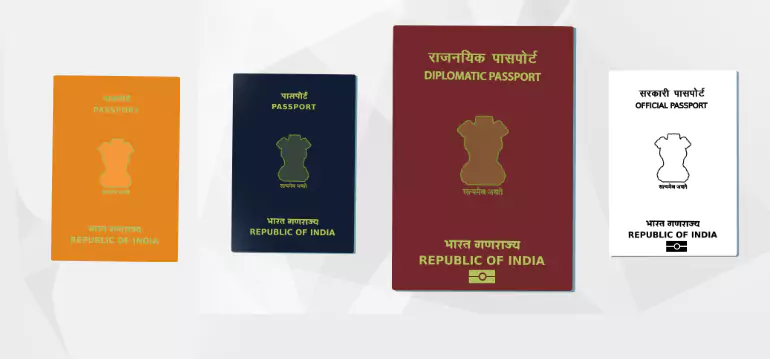
So let’s look at the different types of passports in India by colour:
- Blue Passport (P-Type Passport): This is the most common type of passport colour in India, issued to general Indian citizens travelling for business or leisure abroad. This passport helps the foreign authorities to differentiate between government officials and the general public.
- White Passport (S-Type Passport): These passports are issued to Indian government officials who travel abroad for official purposes. Again, the white passport in India helps immigration officers recognise Indian government officials travelling to their country.
- Maroon Passport (Diplomatic Passport): The diplomatic passport, or maroon-coloured passport, is issued to the highest-ranking government or diplomats serving in embassies and consulates. The maroon passport booklet has 28 pages.
- Orange Passport (Emigration Passport): In 2018, the Government launched the “orange passport” for individuals who are educated below the 10th standard and require an immigration check in place of the ECR passport. However, the government had to reverse its decision due to concerns about discrimination based on educational background.
Note: Besides, the Indian Government has recently introduced updated e-passports for better security and rapid immigration checks.
What is an E-Passport?
An e-passport, or electronic passport, is a traditional paper passport category embedded with an electronic microprocessor chip. This chip securely stores the traveller's biographical data, including their name, date of birth, and a digital signature, as well as biometric information such as a facial photograph. It significantly enhances security, prevents identity fraud, and allows for faster, automated border clearance at immigration checkpoints.
Eligibility Criteria for Different Types of Passports in India
Wondering who gets to travel with a white or diplomatic passport? Here is a quick breakdown of who is eligible for each type of passport issued by the Indian government.
| Passport Category | Different colours of passports in India | Eligibility |
|---|---|---|
| Ordinary Passport | Blue | Ordinary citizens |
| Diplomatic Passport | Maroon | Diplomats (Embassy or Consulate) |
| Official Passport | White | Ministers and Government Officials |
| ECR passport (now discontinued) | Orange | Those who have not completed their education beyond the 10th standard. |
What are the Required Documents for a passport application?
Applying for an Indian passport is a straightforward process as long as you have the right documents ready. Let's look at the essential paperwork required to get your application approved smoothly.
| Type of Evidence | Documents |
|---|---|
| Proof of Date of Birth | Birth Certificate, School leaving/Matriculation Certificate |
| Photo ID Proof | Aadhaar card, voter's ID, PAN card, Driving Licence |
| Proof of Residence | Gas/electricity/water/telephone bill, Rent/Lease agreement |
| Proof of Nationality | Aadhaar card, Voter's ID, PAN card |
Besides, there are some additional documents required for the Official and Diplomatic Passports. Here is the list of those supporting documents:
- Official or Government Identity Card of the applicant
- Official Duty Certificate issued by the Head of Office
- Official Request Letter from your Forwarding Officer
- Clearance Certificate from Prime Minister’s Office (PMO)
What is the Application Fee for Different Types of Passports in India?
The application fee for all types of Indian passports is the same. The only difference lies in the kind of scenario under which the passport application is to be made.
Given below is the list of different scenarios for passport application and the applicable fee:
| Scenario | Type of Passport Booklet/ Passport Category | Application Fee (₹) |
|---|---|---|
| Fresh Passport / Reissue Application | Standard Size Passport (36 pages) | 1,500 |
| Fresh Passport / Reissue Application | Jumbo Size Passport (60 pages) | 2,000 |
| New application/renewal in Tatkal service | Standard Size Passport (36 pages) | 3,500 |
| New application/renewal in Tatkal service | Jumbo Size Passport (60 pages) | 4,000 |
| Duplicate passport in lieu of loss, damage or theft of the passport | Standard Size Passport (36 pages) | 3,000 |
| Duplicate passport in lieu of loss, damage or theft of the passport | Jumbo Size Passport (60 pages) | 3,500 |
| New Passport for Minors (Below 18 Years) | Standard Size Passport (36 pages) | 1,000 |
Did You Know? For a diplomatic (red) or official (white) passport, there is no application fee, as the government issues these passports to the respective VIPs/VVIPs.
How to Apply for a Passport in India?
Applying for a standard Indian passport is a streamlined digital process managed through the official Ministry of External Affairs system. You must complete your application online before attending an in-person appointment for document verification and biometric capture.
Step 1: Register on Passport Seva: Visit the official Passport Seva portal, click on "New User Registration," and create an account for your respective passport office jurisdiction.
Step 2: Complete the Application Form: Log in with your new credentials, select the "Fresh Passport" option, enter your personal details accurately, and submit the form online.
Step 3: Pay and Book an Appointment: Navigate to the "Pay and Schedule Appointment" section to pay your application fee online (mandatory for booking) and select an available date at your nearest Passport Seva Kendra (PSK) or Post Office Passport Seva Kendra (POPSK).
Step 4: Visit the Passport Centre: Arrive at the passport centre on your scheduled date and time with your Application Reference Number (ARN) receipt and all required original documents (proof of address and date of birth) for verification, photographing, and biometrics.
Step 5: Police Verification and Delivery: Undergo the mandatory police verification at your local police station or residence; once cleared, your new passport will be printed and dispatched directly to your address via India Post.
Fact: International travel insurance is compulsory if travelling to a Schengen country. Such a travel insurance plan must cover all medical emergencies and loss of valuables and baggage containing travel documents and passports.
What are the Common Reasons for Passport Rejection?
Having your passport application rejected can derail your travel plans, but most denials stem from preventable administrative errors or incomplete background checks.
- Data Mismatches: Any discrepancy between your application form and supporting documents, such as different spellings of your name, a mismatched date of birth, or incorrect parents' names, will trigger a rejection.
- Invalid or Inadequate Documents: Failing to provide government-approved proof of address or date of birth, or submitting documents that are expired, damaged, or illegible.
- Failed Police Verification: This often occurs if the applicant is not at the provided address during the physical police visit, or if the provided address is incomplete or fake.
- Pending Criminal Cases: Having an undisclosed criminal history, active court cases, or existing arrest warrants that legally restrict you from travelling outside the country.
- Suppression of Facts: Intentionally hiding critical information, such as a previously rejected passport application, a lost passport, or dual citizenship.
- Signature Inconsistencies: If the signature provided during the application process does not match the signatures on your official ID proofs or prior records.
Useful Tips to Keep in Mind While Applying for a Passport
Applying for a passport is a breeze if you do a little prep work beforehand. Keep these quick, practical tips in mind to avoid multiple trips to the passport office:
- Double-check your spelling: Make sure your name, birthdate, and parents' names match exactly across all your documents.
- Don't forget the originals: Bring your original IDs and a set of signed photocopies. The officials have to see the real deal in person.
- Give your real, current address: List exactly where you live right now. The police will visit this address in person, so accuracy is everything.
- Come clean about your history: Never hide a lost passport or a past rejection. The digital system remembers everything, and getting caught lying is a serious offence.
- Stay alert for the police check: Keep your phone handy and try to be available at home. Missing the police visit is the number one reason for delayed passports!
>> Also Read: What is a Visa Number?
Whatever Your Passport Type, Protect It With Travel Insurance
Passport? Check. Peace of Mind? Let’s Talk
From the standard Blue to the diplomatic Maroon, you now know exactly what each Indian passport represents. Your passport is your ultimate key to unlocking the world, whether you are travelling for a well-earned vacation or official government business. However, a passport only gets you into a country; it doesn't protect you once you are there. To guard against medical emergencies, lost baggage, or abrupt flight cancellations, you need a robust travel insurance policy. It acts as an essential financial safety net whenever you leave home. Before you secure your visa, secure your peace of mind, smart travel always starts with being protected.
If you lose your passport during your trip, don't worry at all….. We got you covered!
Before you embark on your journey abroad, you must cover your trip against unforeseen circumstances by purchasing the best travel insurance plan in India. With this plan, you can get covered for the loss of important documents, such as your passport. In case of loss of passport or other travel documents, you can contact the Care Assistance Provider in India, who will provide you with consular access to the Consulate or Embassy of the destination country.
Disclaimer: All plan features, benefits, coverage, and claims underwriting are subject to policy terms and conditions. Kindly refer to the brochure, sales prospectus, and policy documents carefully.
