
Subscribe to get weekly insights
Always stay up to date with our newest articles sent direct to your inbox
Published on 28 Feb, 2026
favorite0Like
favoriteBe the First to Like
236 Views
2 min Read

When you think about weight loss, you usually picture the "big two": the gym and the plate. You count calories, measure macros, and track your steps. But what if the most important factor in your fitness journey isn't what you do while you’re awake, but what happens while you’re asleep?
Recent studies suggest that within just four days of insufficient sleep, your body’s efficiency to process insulin could drop by a whopping 30%!
If you are doing everything right in the kitchen and the gym but still aren't seeing results, sleep might be the missing ingredient.
The relationship between sleep and weight loss isn't just about having more energy to exercise; it’s a complex chemical dance involving your hormones, your brain's reward centres and your cellular insulin sensitivity.
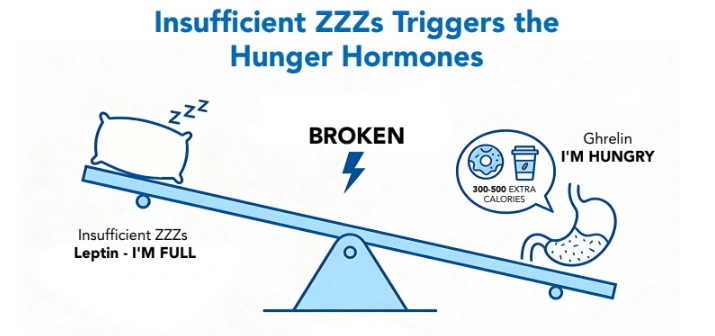
Think of your appetite like a seesaw. On one side, you have Leptin, the hormone that tells your brain, "I’m full, stop eating." On the other hand, you have Ghrelin, the hunger hormone that signals hunger to your brain.
When you are sleep-deprived, this seesaw breaks. Studies have shown that a lack of sleep causes Leptin levels to plummet and Ghrelin levels to spike.
The result? You wake up in a state of biological hunger that no amount of willpower can overcome. You aren't just tired; your body genuinely believes it is starving, leading to an average intake of 300 to 500 extra calories the following day.
____________________________________________________________________________
Have you ever noticed that after a late night, you don't crave a kale salad?
You want a bagel, a doughnut, or a double espresso with extra syrup. This isn't a lack of discipline; it’s a neurological shift.
Sleep deprivation dulls decision-making and impulse-control activity. Simultaneously, it over-stimulates the amygdala, the brain's reward centre.
When you're exhausted, your brain’s brakes are cut, and its gas pedal for junk food is floored. You become neurologically primed to seek out high-calorie, high-sugar foods for a quick hit of dopamine.
Just one night of shortened sleep could induce temporary insulin resistance.
When you are sleep-deprived, your fat cells become less sensitive to insulin. Instead of processing sugar from your bloodstream into energy, your body pumps out more insulin to compensate. High insulin levels signal the body to store fat rather than burn it. In essence, by skipping sleep, you are biologically telling your body to hold onto every calorie you consume.
____________________________________________________________________________
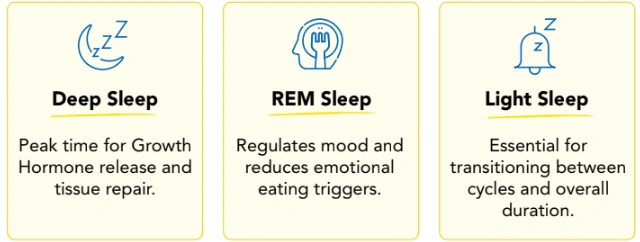
It’s not just about the amount of sleep, but the quality. During Deep Sleep (Slow Wave Sleep), the body undergoes its most significant physical repair. This is when Growth Hormone is released, a key player in muscle recovery and fat metabolism. If your sleep is fragmented or too short, you miss out on this prime fat-burning window.
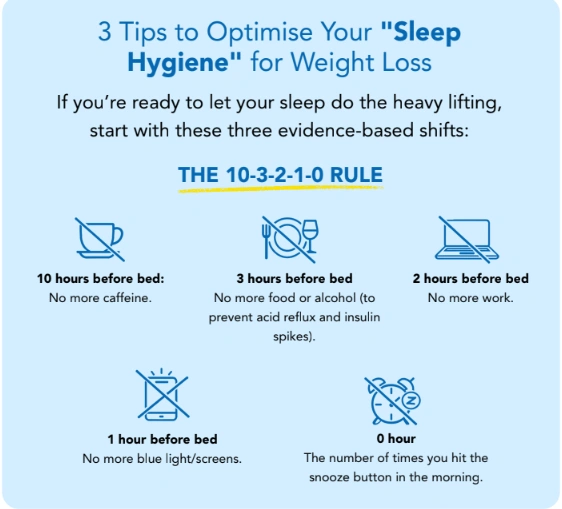
Keep it Cool: Your body temperature needs to drop to initiate deep sleep. Aim for a bedroom temperature around 18°C (65°F).
Morning Sunlight: Get 10 minutes of natural light as soon as you wake up. This anchors your circadian rhythm, ensuring your "sleep drive" builds up correctly for the following night.
We live in a culture that treats sleep as a luxury or a sign of laziness. In reality, sleep is a performance enhancer. If you treat your sleep with the same discipline you apply to your macros, you’ll find that weight loss becomes less of a gruelling uphill battle and more of a natural biological process.
Tonight, the best thing you can do for your waistline is to turn off the TV, dim the lights, and go to bed.
We develop more topics like this every month. Stay tuned to receive insightful articles directly in your mailbox!

favoriteBe the First to Like
